Fogleman: Policy blunders helping along higher energy costs
In many ways, Colorado’s natural gas reserves have been the goose that laid the golden egg.

In many ways, Colorado’s natural gas reserves have been the goose that laid the golden egg.

Jared Polis has now shown he has the ability to stand up to the communists in his tribe. Soon we’ll find out if he has the guts.

So why again does our state government want to ignore the voice of the people and levy sweeping new regulations on our increasingly safe oil and gas industry?

The commission’s suppressive tactics played into the hands of anti-oil and gas groups, who had nowhere else to be and happily filled the speaking slots of energy workers, industry experts and community leaders who couldn’t stay indefinitely.

While the state is trying to force us into Boulder control, our county officials, with community support, are pushing forward with our own Weld County control, which hasn’t gone unnoticed.

“He looked us in the eye and he said, ‘How you do business in Weld County will not change. You’re right Gov. Polis, because the actions we (took) today will ensure that it does not change. … We’re here to make sure Gov. Polis and his political operatives keep their promises.” Weld Commissioners Scott James and Barbara Kirkmeyer.

What major legislation has Polis signed that reduces government’s economic footprint?

They’re just lawmakers whose intentions are good; oh, please don’t let them be misunderstood.

“If we don’t harness this enthusiasm to unify and advance the industry in Colorado, then shame on us.” Dustin Case.

“I’m sure the commissioners have had that vetted, and we’re having it vetted. I don’t know how we’ll see it, but I appreciate that the county is looking out for the interest because its going to affect us all.” — Greeley Mayor John Gates

Greeley and Evans’ own state representative supports destroying our region’s chief economic driver and the thousands of jobs it provides, and yet somehow thinks that it can be remedied by forcing those soon-to-be-unemployed workers into government-run retraining programs.

“Men and women who truly care about our state, rejected oil and gas extremism in 2018. If it comes to it, we know they’ll do it again in 2020.” Barbara Kirkmeyer and John Brackney on 181 Repeal

About 35 years ago, Steve Schuck, a good friend and political ally called me and proclaimed, “There’s someone you must meet.” “Who, why and when,” I asked. “Immediately, he replied, “time is of the essence.” So, a meeting was arranged for the next day. The man was Bob Coté. We met at Bob’s workplace, a somewhat dilapidated building at 21st Street and Larimer St. in what was then Denver’s skid row. The building housed Step 13, a tough-love, sobriety-first recovery community for homeless men in Denver.
Bob had been a successful salesman but succumbed to alcoholism and wound up hitting bottom, homeless on Denver’s skid row. Step 13 helped him rebuild his life. He returned the favor by taking a job there to help others and was soon running the place and determined to save it. This was a tough neighborhood and Bob was a tough hombre, a former Golden Gloves boxer. There were days he’d have to defend his turf armed with a baseball bat from vandals and drunks.
Bob explained the program he’d crafted and why it works, based on three pillars; Sobriety: Detox, mandatory abstinence, and random testing. Work: Residents have to be employed and pay rent. Accountability: No excuses, strict rules, peer support and bonding.
And no connection with or funding by government. The politics and bureaucracy associated with that is poison. To this day, Step has never taken a nickel of government money. Bob sold me and we became fast friends for many years. He was one of a kind, larger than life and overflowing with charisma. Bob would boast he had a doctorate in “streetology” and could see through any wavering resident’s phony excuses. An article in American Enterprise magazine described him as “a one-man alternative to the welfare state. Take one part Florence Nightengale, add three parts John Wayne, and one part cowboy poet…running a shelter that turns homeless junkies into productive citizens.”
So, I asked how I could help. Bob said, look around at the building, Denver is threatening to close us down for code violations, turn off the water and electricity, and we have a lot of bills to pay. I said its December, a good time to be charitable. How about we do a remote broadcast on my KOA radio show from your building for all three hours? You can tell everyone about your program, your philosophy, and your mission. I know my audience would love what you’re doing. We’ll call it a radiothon and raise a few bucks.
A couple of days later we did just that. My first caller that day, a personal friend with a business in Parker, Dave Stump, pledged $5,000. Other businesspeople offered jobs for Bob’s residents, checks poured in for days and we raised about $50,000 in all. And for the next three decades we did an annual Step 13 radiothon each December. Other philanthropists like Joe Coors, Cort Dietler, and Phil Anschutz were very generous to Step 13 especially in its early days of need. And Peter Boyles was a major supporter.
Bob Coté passed away in 2013. In 2017 Step 13, changed its name to Step Denver so it could differentiate its venues as it expands into other communities, like Step Springs in Colorado Springs, which will celebrate its first anniversary as a new 50-bed residential program on October 28 with an Open House. Here’s an opportunity to check out this facility for yourself or a loved one. Meghan Shay joined Step in 2019 and is now the CEO of Step Recovery, the parent organization for Step Denver, Step Springs, and future sites to come. (If Step Denver is more convenient for you, Meghan would be pleased to arrange for a visit there.)
What remains constant is Step’s dedication to Bob Coté’s vision. Numerous Step alumni have joined the staff after their personal recovery, most notably Bob himself, all of the Denver staff and more than half of the Step Springs staff, including Andre Podpolucha, now the Chief Operating Officer of Step Springs, who just four years ago was living under a bridge. This speaks volumes about their belief in the program, their ability to empathize with residents and serve as role models.
The fatal flaw of government-run “homeless” programs for substance addicts is their insistence on “housing first.” This is compassion without common sense. Without a commitment to personal responsibility and accountability on the part of addicted residents such programs reward bad behavior and become little more than storage centers for permanent addicts.
Longtime KOA radio talk host and columnist for the Denver Post and Rocky Mountain News Mike Rosen now writes for Complete Colorado.

Colorado’s western slope has long provided energy and natural resources to the state, but state energy policy is affecting how that energy is being used. What will happen? PowerGab Host Amy Cooke discusses this topic and more with Wade Haerle, the Executive Director of Club Twenty.
Show Notes:

How do we make sense of this crazy election? Well, we ask Marianne Goodland from the Denver Gazettes and Colorado Politics.
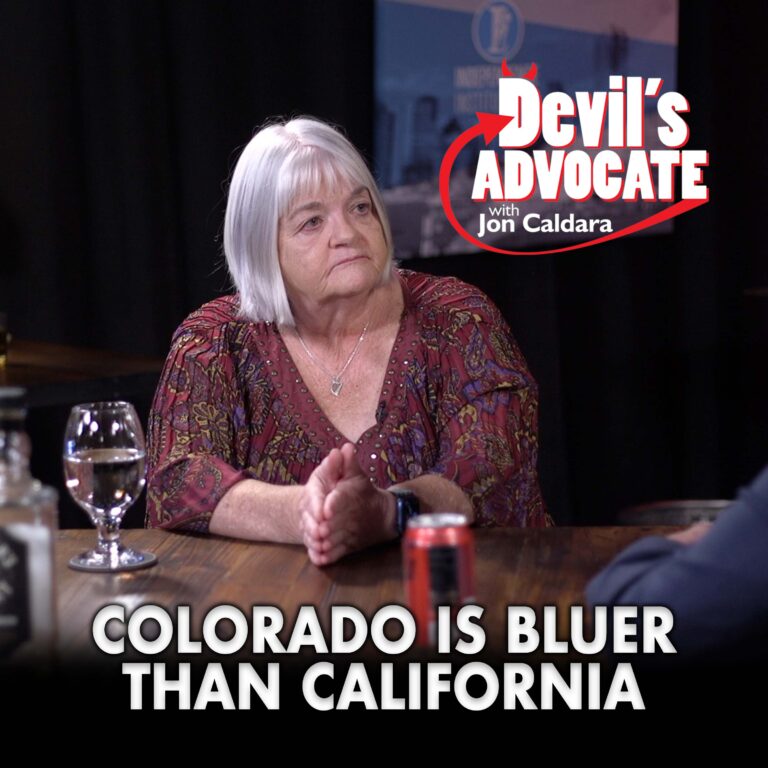
Colorado just experienced a political earthquake and the results have left even veteran political observers stunned. Is Colorado now bluer than California? What happened to the Colorado Republican Party? And what does an overwhelming Democratic majority mean for the state’s economic and political future? On this episode of Devil’s Advocate, Jon Caldara sits down with veteran political journalist Marianne Goodland of Colorado Politics and The Gazettes to break down the election results, the Republican Party’s stunning losses, and the dramatic shift in Colorado’s political landscape. From surprising Democratic victories in traditionally Republican strongholds like El Paso and Douglas counties to the growing power of progressives at the State Capitol, this election could reshape Colorado for years to come. **In this episode:** – How Colorado became one of the bluest states in America – Why Republicans suffered devastating losses across Colorado – Donald Trump’s impact on Colorado’s election results – The Democratic supermajority and what it could mean for taxpayers – Surprising results on taxes, energy, and social issues – Why voters supported conservative ballot measures while electing Democrats – The potential consequences of Colorado’s progressive income tax – Growing concerns about business regulations, energy costs, and companies leaving Colorado – Colorado’s $1.6 billion budget deficit and the future of Medicaid – Whether Colorado is following California’s political and economic path Marianne also explains why this election was unlike anything she’s witnessed in her years covering Colorado politics and why the next few years could bring even bigger changes. Is Colorado becoming the next California? Or has it already gone further? Watch the conversation and tell us what YOU think in the comments.